Maison – Voyage – Paysage
Anna Krammig · Rachel Lumsden · Pascal Sidler
We are very pleased to introduce the group exhibition Maison – Voyage – Paysage. This exhibition presents three positions of figurative painting in Switzerland through works by Anna Krammig, Rachel Lumsden and Pascal Sidler. The keywords in the exhibition title can be associatively linked to the thematic orientation and formal approaches of the three artists.
Until recently, figurative painting led a shadowy existence in Switzerland. The constructivist–concrete legacy weighed heavily: not only in Zurich, but even in the Romandie, Neo-Geo was the dominant approach. In art schools, representational painting was hardly discussed at all. When the British-Swiss artist Rachel Lumsden came to Switzerland in 2001, her representational pictorial explorations were met with complete incomprehension by the leading figures in the art world. Representational painting was not taken seriously but relegated to the realm of hobby painting. During the pandemic, Lumsden wrote the book Igniting Penguins – A Manifesto for Painting (Ritt auf der Wildsau – Manifest für die Malerei) published in 2023. In it, she reflects on her experiences as a representational painter in Switzerland. In the meantime, the status of representational painting has changed dramatically – not only in Switzerland, but worldwide. It is now one of the most popular art forms.
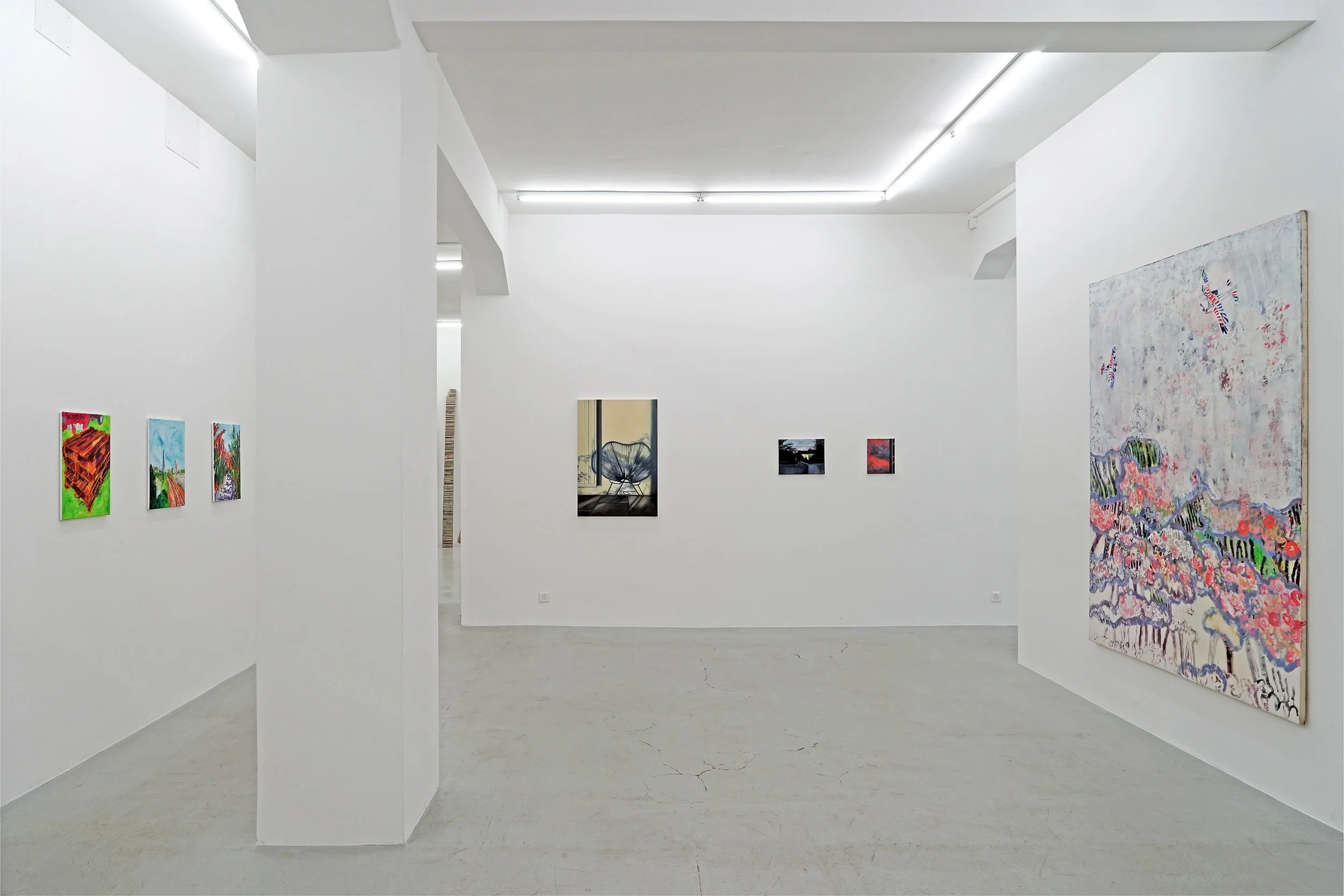
Anna Krammig was a Meisterschülerin in the class of Karin Kneffel, a representational painter who herself had studied under Gerhard Richter. In Germany, Krammig was never confronted with hostility toward figurative painting. It was only when she completed a master’s degree at the Zürcher Hochschule der Künste (ZHdK) that she realized representational painting was not considered current in Switzerland. She was not deterred by this, however, and consistently continued her painterly, figurative practice. Krammig builds her delicate paintings layer by layer using glazes, allowing individual brushstrokes to disappear. Her source material always consists of her own photographs or those taken by people she knows. This familiarity with her image sources is reflected in her carefully considered, sometimes melancholic and enigmatic painting. She often captures southern locations, depicts interiors, or devotes herself to plays of light that exert a particular fascination on her. As a rule, these are not spectacular images, but everyday moods: incidental landscapes, ordinary furniture, chairs, lamps, or views through windows, which Krammig transfers from her photographic notes. The orchestration of light, the interplay of light and dark that carries an inherent sense of drama, plays an important role in her painting and evokes associations with suspenseful film stills. The built environment, the immediate surroundings, constitute an important thematic point of reference in her work.
Anna Krammig, Untitled (Lamp Pini), 2026
Oil on canvas, 100 x 70 cm
Anna Krammig, Untitled (Casa), 2026
Oil on canvas, 30 x 40 cm
Anna Krammig, Untitled (Sky Luise 7), 2026
Oil on canvas, 30 x 24 cm
Rachel Lumsden trained her eye through the figurative paintings on view in London, including works by John Constable, J. M. W. Turner, Walter Sickert, and Francis Bacon. The tradition of figurative painting in England was never lost; consequently, the paintings in the National Gallery in London have always been an important source of inspiration. For her pictorial inventions, Lumsden draws on her own extensive image archive on the one hand, while on the other hand spontaneous intuitions arise during the painting process. Art-historical references also appear within her visual worlds. The starting point of her work is the choice of motif, which determines the format of the painting. From there, she allows herself to be guided by the painting process itself. In this context, the selection of colours and the placement of deliberate brushstrokes are decisive. Lumsden describes her working method in vivid terms: “My creative process begins in seeing, noticing things, in perceiving objects and patterns in the world around me. Subject matter for me is less a strategic choice than a question of resonance.” Lumsden places great importance on finding a balance between content and form in her paintings. “The motif is painted in and perhaps painted out again or partially lost. Eventually the true subject matter emerges out of the painting process.” Lumsden often chooses large formats for her paintings giving her wider possibility to make them immersive. A solid support is important to her, as it allows her to make changes to the composition by providing resistance to the application of paint.
Rachel Lumsden, Take Me, 2025
Oil on cotton, stretched on poplar wood, 210 x 170 cm
Rachel Lumsden, 12 O'Clock High 2, 2025
Shellac, ink, and oil on cotton, stretched on poplar wood, 210 x 170 cm
Rachel Lumsden, Excursion, 2024
Oil on cotton on MDF, 29.7 x 21.5 cm
Rachel Lumsden, Almost Like It Was, 2024
Oil on cotton on MDF, 29.7 x 21.5 cm
Rachel Lumsden, Sodium Night, 2024
Oil on cotton on MDF, 21.5 x 29.7 cm
After studying art in Zurich and Basel from 2010 to 2015, Pascal Sidler devoted himself to a range of different painterly approaches. Initially, he explored his immediate living environment in large-scale figurative oil paintings: a stairwell, a group of bicycles, a frying pan, a park bench, legs on a sofa, and so on. He then turned to abstraction, breaking down smartphone photographs on the computer using 3D software into linear and planar elements, and subsequently constructing multilayered images in a further working process that display a high degree of artificiality. Since 2024, Sidler has been working on a group of smaller figurative oil paintings which, at first glance, appear completely different from his abstract computer-based experiments. On closer inspection, however, it becomes clear that the two bodies of work share notable similarities in their approach. The representational paintings also contain a sense of casualness in their depiction. The motifs might seem arbitrary, which is further intensified by the titles and the free painterly manner of the works. The discrepancy between image and title creates a peculiar semantic void that calls for interpretation. The titles confer an additional layer of meaning on the paintings – most of which are landscapes – that, in a surprising way, does not correspond to the visual representation.
Pascal Sidler, My moon is green, my mood is back, 2025
Oil on canvas, 50 x 40 cm
Pascal Sidler, Yeah yeah you think you run this town, 2025
Oil on canvas, 50 x 40 cm
Pascal Sidler, When I was going somewhere in a car, 2025
Oil on canvas, 50 x 40 cm
Pascal Sidler, But the morning sun that lights your cheek, 2025
Oil on canvas, 50 x 40 cm
Pascal Sidler, And everything falls apart, 2024
Oil on canvas, 40 x 50 cm
Pascal Sidler, Mysterious lights, 2025
Oil on canvas, 40 x 50 cm
A comparative view of the works by Krammig, Lumsden, and Sidler makes it clear that works subsumed under the umbrella term figurative painting can be very different in nature. Only through closer examination does the pictorial quality of the individual modes of expression become apparent—regardless of their designation.
Anna Krammig (*1981, Heidelberg, DE) Education at the École Régionale des Beaux-Arts de Nantes, FR; painting class with Prof. Karin Kneffel, University of the Arts Bremen & Academy of Fine Arts Munich, DE; Meisterschülerin of Prof. Karin Kneffel; Master of Fine Arts, Zurich University of the Arts (ZHdK); numerous awards and grants; exhibitions in Switzerland and abroad.
Rachel Lumsden (*1968, Newcastle upon Tyne, UK) Education at Nottingham Trent University and postgraduate studies at the Royal Academy Schools, London; numerous awards including the Pollock-Krasner Award (USA); Art Prize of the City and Canton of St. Gallen and Thurgau; work contribution from Pro Helvetia; solo exhibitions in Switzerland and abroad, including Kunsthaus Pasquart, Biel, Kunstverein Konstanz and Villa Bernasconi, Grand-Lancy near Geneva.
Pascal Sidler (*1989, Zurich, CH) Bachelor’s degree from the Zurich University of the Arts (ZHdK) and Master’s degree from the Basel School of Design and Art (FHNW); several awards from the City and Canton of Zurich; nomination for the Swiss Art Award; group exhibitions at Helmhaus, Zurich, Kunsthalle Basel, Kunstmuseum Singen (DE) and numerous off-spaces, including Hamlet and Kobo Art Space, Zurich.