Fragments of Narration
with works by Anne-Lise Coste, Slawomir Elsner, Franziska Furter, Eleni Gkinosati, Bob Gramsma, Rachel Lumsden, Koka Ramishvili and Dieter Roth.
We are delighted to present the exhibition Fragments of Narration, in which we feature works by seven artists from our program and one guest. A remark by the conceptual artist Simon Starling in his current exhibition at the Kunst Museum Winterthur provided the title for the show. Every artistic work is part of a larger, comprehensive practice. To grasp the peculiarities of individual pieces, it is important to know the complete œuvre of the respective artists. Furthermore, each work contains its own internal references and provides fragments of a larger narrative.
Bob Gramsma, Blue Hour Cafe, OI#26359, 2026, Polymer plaster, coffee, argon Cast in green sand: coffee, bentonite, and sea coal, 20 x 110 x 12 cm
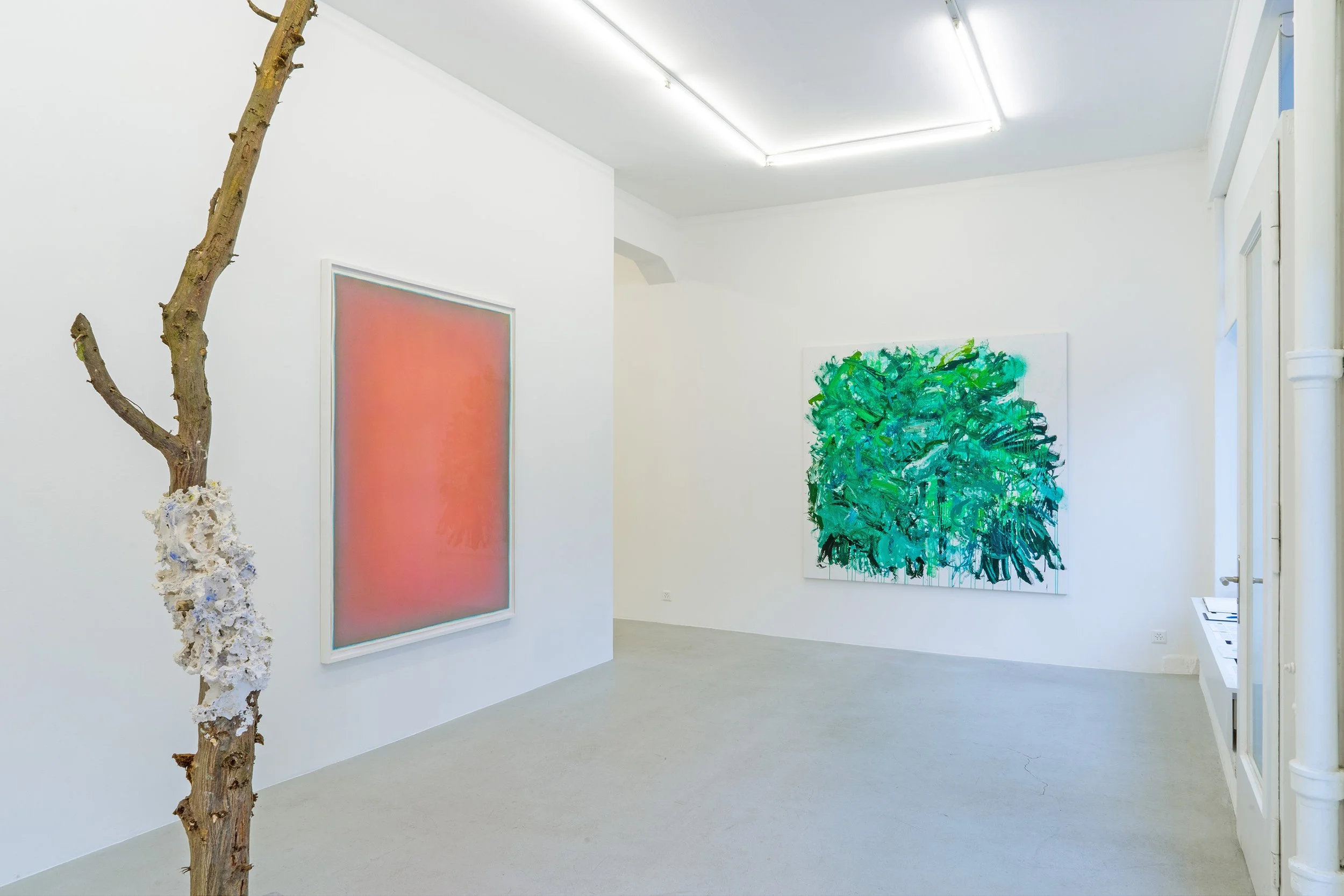
Bob Gramsma, Entlang Nebelmulden und Waldkanten, OI#26360, 2026, Polymer plaster, pigments, European beech, garden slabs, cement mosaic tiles Cast in green sand: quartz sand, bentonite, and sea coal, 190 x 50 x 50 cm
Dieter Roth, Selbstbildnis als Luftbewohner, 1973, 7-colour offset printing (three printing passes) on Rives handmade paper, Ed. 14/30, Image: 53.5 x 82.5 cm; sheet: 65.5 x 93.5 cm
Bob Gramsma
–, OI#26357, 2026
Creatine, OI#26354, 2026
Creatine, OI#26355, 2026
Creatine, OI#26356, 2026
Creatine, OI#26353, 2026
–, OI#26358, 2026
partially Creatine on SnPb Alloy on Bulletproof Thread Cast in Green Sand: Bentonite, Silica Sand and Sea Coal, from 11 x 9 x 8 cm to 13 x 10 x 15 cm
Bob Gramsma (*1963, lives in Zurich) is one of the most significant Swiss sculptors. Known for expansive Land Art, here he is consciously dedicating himself to the small scale, which adds a new dimension to his formal language. Gramsma constantly experiments with industrial mixtures and coatings: this time he surprises with a hybrid tree sculpture with accents of polymer plaster. Behind it, a neon work shines through a plaster surface mixed with coffee powder, while six small sculptures, some bearing small piles of creatine, hang in the window display. Through these organic, body-influencing substances, Gramsma adds a fleeting, conceptual layer to his material-based research. At the center of his work remain relational gaps in which human presence, atmospheric processes, erosion, and temporality materially inscribe themselves.
A high-hung self-portrait as a sky dweller by Dieter Roth (1930-1998) complements the group of works in the first room. Roth often portrayed himself in self-portraits, particularly in the early 1970s, where protruding ears and the indentation on the head are a recurring characteristic.
Eleni Gkinosati, Untitled, 2024
Oil on canvas, 185 x 194 cm
Slawomir Elsner, From the Series Just Watercolours (101), 2022
Watercolour on paper, 178 x 136.5 cm
The large-format green painting by Eleni Gkinosati (*1990 in Athens, lives in Athens) was created in 2024 during a residency in St. Moritz. In this work, the artist processes visual impressions from her surroundings, which are often only indirectly visible. Starting with spontaneous lines and marks, the painting evolves step by step. The working process is characterized by an alternation of observation, pauses and periods of concentrated work. In doing so, Gkinosati relies on her experience and artistic intuition, without following a fixed concept. The result is a style of painting that is both intuitive and deliberately crafted.
A watercolor by Slawomir Elsner (*1976 Wodzislav Slaski PL, lives in Berlin) hangs in the center of the room. This work was created for his major solo exhibition at the Staatliche Graphische Sammlung in Munich in 2024. For this show, Elsner conducted an in-depth examination of Peter Paul Rubens's famous painting, Rubens and Isabella Brant in the Honeysuckle Bower, from 1609/10. In 17 pictures, he showed various possibilities for visual interpretation and adaptation. Among them is this radiant watercolor. In this work, Elsner refers to the unfathomable coloring of the carnelian, a reddish-shimmering semi-precious stone that Rubens's wife, Isabella Brant, wears in her bracelet in the painting. It is no surprise that Elsner, with his extraordinary sense of color, reacts to these specific colors in Rubens's painting. The gold border in the watercolor echoes the setting of the semi-precious stone in the bracelet.
Franziska Furter, Always on my Mind, 2026, ink on paper, 200 x 160 cm
Rachel Lumsden, Hour, 2026, oil on cotton, stretched on poplar wood, 210 x 170 cm
Franziska Furter, Island/Qeqertaq, 2026, metal, wire, 45 x 27 x 30 cm
In the main room, the large red work on paper Always on my Mind by Franziska Furter (*1973, lives in Basel) welcomes the audience. Furter often incorporates visual elements from her immediate surroundings. This work continues her playful engagement with manga backgrounds, as the artist relies on standardized depictions of explosions by manga draftsmen. The work is part of a series started in 2023 (three of these ink works are currently on view in the Zurich Design Museum exhibition "Pling! Design hören"). Through the white negative space in the center of the image, Always on my Mind unfolds an immense pull. Opposite in the room, another work by Furter can be seen—an object made of metal and wire that connects to the older series Island. Characteristically, Furter returns to familiar mediums and themes after longer breaks. This creates an oeuvre that is fragmented over the years but deeply interwoven. In the showroom, we also present Flow, a new series of drawings that emerged from Furter's fascination with the element of water and the inspiration from Augusto Giacometti's painting Bergbach at the Bündner Kunstmuseum in Chur.
Rachel Lumsden (*1968 Newcastle-upon-Tyne UK, lives in Schaan FL) is a figurative artist educated at the Royal Academy Schools in London. The English tradition of figurative painting is central to her. She draws on her rich visual archive but also allows spontaneous inspirations during the painting process. The starting point of her work is the choice of the motif, which determines the picture format. After that, she is guided by the painting process. Here, the combination of colors and the placement of decisive brushstrokes are leading the way. She describes it like this: "My creative process begins with seeing, perceiving things, objects, and patterns in the world around me. The subject is for me less a strategic decision than much more a question of resonance."
Koka Ramishvili, Vineyards, 2026
Oil on canvas, 61 x 50 cm
Koka Ramishvili, Evening in Blue – Viridian, 2026
Oil on canvas, 60 x 50 cm
The Georgian-Swiss artist Koka Ramishvili (*1956 Tbilisi GE, lives in Geneva) has recently been engaging more intensely with oil painting alongside photography and installation. In a series of oil paintings created partly without a brush—merely by distributing paint on the surface using fabric elements—he depicts enchanted landscapes. At the end of 2025, we showed his solo exhibition Coordinates. In this context, Ramishvili described how his works become coordinates in the world: markers of light and ambiance by which one can be guided and touched. These two newer works can be understood as landscapes on this exact map.
Anne-Lise Coste
Eros, 2015, airbrush on wooden door, 216 x 81.5 x 7 cm
Poème, 2022, neon, Ed. 3 + 1 AP, 30 x 77 cm
By Anne-Lise Coste (*1973 Marignane FR, lives in Paris), a door is on display upon which she has sprayed black hearts and sweeping "L" letters that correspond with the middle initial of her name. L O V E is written once, and aerosol can be sensed. Her oeuvre can hardly be fully comprehended without the omnipresent elements of text and writing. Equally characteristic is her urge to rely on alternative materials beyond the canvas, such as discarded doors. In the hallway hangs the neon work Poème, based on the artist's handwriting, which transitions into the showroom. While these works are part of older work cycles, we present a 2025 series with Fly Fly in the showroom. In these works, Coste proceeds introspectively: she leaves a lot of air on the paper, brings only a few precise elements into play, and leaves it to the audience to complete the scene in their mind's eye.
Anne-Lise Coste, Poème, 2022
Neon, Ed. 3 + 1 AP, 30 x 77 cm
The exhibition illustrates that every artwork contains fragments of narrative in different forms. It is up to the viewer to discover these and complete them through imagination.
Anne-Lise Coste (*1973 in Marignane FR, lives in Paris) studied in Marseille and in Zurich. After many years in Zurich, a multi-year stay in New York, and in the South of France, she now lives in Paris. Her drawings and text works possess the immediacy of graffiti art, enabling her to mix subjective moods with political critique and literary sentences. With language influenced by the Dada movement and lyrical images, her work radiates irony, rebellion, and emotion. Through the immediacy of the drawing gesture, she combines a strict poetic sense with an element of social criticism. Her work is represented in many public and corporate collections, including the Stedelijk Museum, Amsterdam; MACBA, Barcelona; FRAC des Pays de la Loire; Migros Museum für Gegenwartskunst; Collection of the Swiss National Bank; Collection of Deutsche Bank. She has held numerous solo exhibitions, including at the Musée d'art Contemporain de la Haute-Vienne, Château Rochechouart, Kunsthalle Baselland, the Dortmunder Kunstverein, Germany, the CRAC in Sète, the Salomon Fondation in Annecy, France, and the Kunsthaus Baselland.
Slawomir Elsner (*1976 in Wodzislav Slaski PL, lives in Berlin) focuses on works on paper in the form of luminous watercolors and colored pencil drawings. In his colored pencil drawings, he explores the color spectrum and compositions of famous Old Master paintings. Instead of using "classical" line drawing, which defines volume and space through individual lines, Elsner encircles the pictorial space with hundreds of bundles of straight lines. Elsner's work is in the following public collections: Kupferstichkabinett der Staatlichen Kunstsammlungen, Dresden; Kupferstichkabinett Staatliche Museen zu Berlin; Bechtler Museum of Modern Art (Charlotte, North Carolina, USA); KiCo Foundation permanent loan to the Lenbachhaus, Munich; Staatliche Graphische Sammlung, Munich. Important corporate collections and foundations own his works, including the Collection of Deutsche Börse, Frankfurt a.M.; Cusanuswerk, Bischöfliche Studienförderung Bonn; Rubell Family Collection, Miami; Collection of LBBW, Stuttgart; Ostsächsische Sparkasse, Dresden; me Collectors Room, Berlin; Roche Art Collection, Basel.
Franziska Furter (*1972 in Zurich, lives in Basel) began her career as a draftswoman. She has remained faithful to the medium of drawing, but over the years has supplemented it with sculptural works and installations that always reveal her affinity for drawing. In her exhibitions, she continually develops new groups of works. She always works with the utmost care and meticulousness: like a researcher, she experiments and expands her visual vocabulary. In her work, she always remains tangible as the executing author. All of Furter's works touch upon questions regarding the perception of time and play with the criteria of planning, concept, and chance. Her work has been shown in many solo and group exhibitions in Europe. Her works can be found in the following collections, among others: Kupferstichkabinett, Kunstmuseum Basel; Aargauer Kunsthaus, Aarau; Museum of Modern Art, New York, and in many private and corporate collections, including Zürcher Kantonalbank; Collection of Deutsche Bank, Zurich and Frankfurt a/M; Credit Suisse Collection; UBS Art Collection, Bank Bär Collection; Roche Collection, Basel; Collection of Mobiliar and Helvetia Insurance.
Bob Gramsma (*1963 in Uster, lives in Zurich) has a BA in Fine Arts from the ArtEZ University Arnhem and an MA in Fine Arts from Ateliers Arnhem. Gramsma has received numerous awards, including the UBS Art Award, the Swiss Art Awards, work grants and contributions from the City and Canton of Zurich and the Dutch Mondriaan Foundation, the PS1 MoMA studio program from the Federal Office of Culture, as well as private and public foundations. Gramsma has realized works for public spaces and percent-for-art projects internationally. His works have been presented in national and international exhibitions, including the Kunstmuseum St. Gallen, Kunsthaus Zurich, Kunstmuseum Bern, Kunsthaus PasquArt, and the Venice Architecture Biennale. His works are located in renowned collections at MAC Lyon, FRAC Alsace, Collection Land Art Flevoland, Palestinian Museum, Kunstmuseum St. Gallen, Collection of the Federal Office of Culture, Julius Baer Collection, Credit Suisse Collection, Art Collection of the City of Zurich and the Canton of Zurich, Die Mobiliar, among others.
Eleni Gkinosati (*1990, Athens, Greece) lives in Athens. Following a classical painting training at the Athens School of Fine Arts, she completed a further Master’s degree at Kingston University of London. Her work has been shown in numerous group and solo shows, amongst others with The Breeder, Athens, Bombon and Prats Nogueras Blanchard in Barcelona at L’Antiga Farinera in Corçà Empordà, Spain, Galerie Krinzinger, Vienna, Apalazzo Gallery, Brescia and Luis Adelantado Valencia.
Rachel Lumsden (*1968 Newcastle-upon-Tyne UK, lives in Schaan FL) began her studies at Nottingham Trent University and continued them with postgraduate studies at the Royal Academy Schools in London. She has been living in Switzerland since early 2000. From 2007 to 2019, she was a lecturer in painting at the Lucerne School of Art and Design. She has had numerous solo and group exhibitions at home and abroad, including at the Coleman Projects in London, the Haus der Kunst in Solothurn, Kunstverein Konstanz, Kunsthaus Centre d'art Pasquart Biel, Fondation Fernet-Branca in St. Louis, Villa Bernasconi in Grand-Lancy near Geneva, and the Kunstmuseum Thurgau, Kartause Ittingen. She has received numerous awards, including the Pollock-Krasner Award, and the Art Prize of the City of St. Gallen and the Canton of Thurgau. In 2023, her book Igniting Penguins: A Manifesto for Painting was published. Her works are in numerous private and public collections.
Koka Ramishvili (*1956 in Tbilisi GE, lives in Geneva) studied industrial design, architecture, and film at the State Academy of Arts in Tbilisi. As a multidisciplinary artist, he has participated in important solo and group exhibitions since 1990 in Berlin, Glasgow, at the Arnolfini in Bristol, and at the Galerie Häusler Contemporary in Munich. In 2000, he moved to Geneva. Since then, his work has been exhibited in numerous cultural institutions across Europe, including the Tate Modern, London; MAMCO, Geneva; Goethe-Institut, Berlin; Musée des Beaux-Arts, Nantes; Museum Folkwang, Essen; M HKA Museum of Contemporary Art, Antwerp; Musée des Beaux-Arts, Nancy; and the Cobra Museum, Amsterdam. Koka Ramishvili represented Georgia at the Venice Biennale 2009.